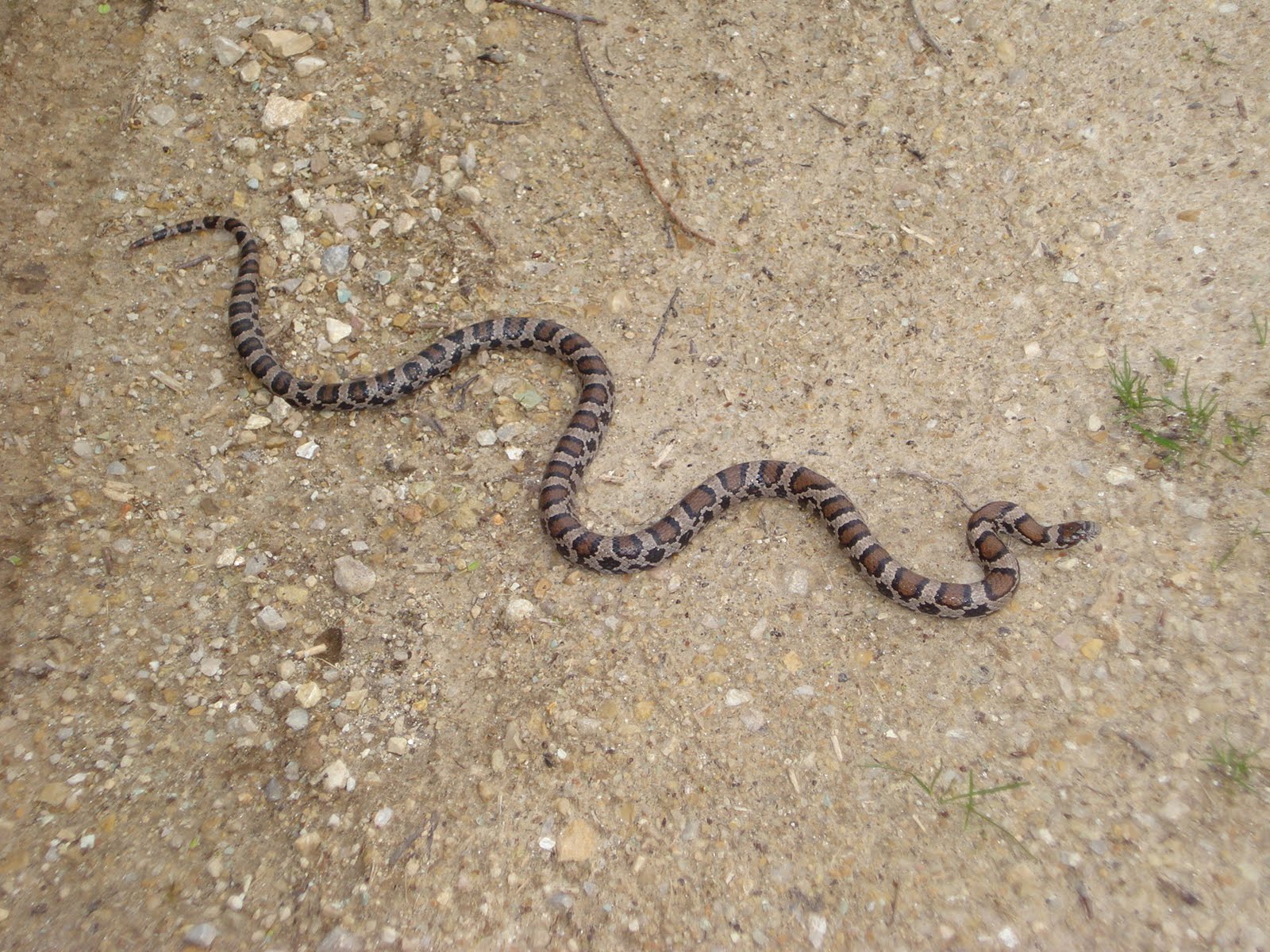
When Bill pulled a tarp off of a compost pile he found 5 more Milk Snakes.
Showing posts with label snakes. Show all posts
Wednesday, May 11, 2011
Plowed fields
This is the field that has seasonal creekbed spill and fines from last year when the culvert was replaced. It is topped with compost. We will put our over 100 pepper plants here. First, since my seedlings are late this year - a quick smother crop of buckwheat that will get incorporated in mid June when we plan to plant. (Late... I know...)
When Bill pulled a tarp off of a compost pile he found 5 more Milk Snakes.

This is Field 1 and Field 2. Bill plowed today. He also got #3 done. I can't wait to see them - I go up on Thurs night but won't get out there until Saturday.
When Bill pulled a tarp off of a compost pile he found 5 more Milk Snakes.
Saturday, May 7, 2011
Milk Snake!
While doing some clean up last weekend at the farm, we happened upon a snake sunning itself in the driveway.

Round eyes
Didn't strike at the stick


After some internet research, we've decided that it is a Milk Snake. Milk Snakes are often mistaken for a Bull Snake (which is an endangered snake) as they have somewhat similar markings. Milk Snakes' markings are very saddle shaped with a dark outline. They have round eyes - I learned that round eyed snakes are not poisonous. They don't have a rattler, but they often shake their tail when disturbed and it can sound like a rattle if there is leaf litter nearby. Preferred living conditions are valleys and farmsteads where there is water (our farms perfect!). They eat mice, voles and insects and kill their prey via squeezing it until it can no longer breathe a/k/a constricting. Once their prey is dead they swallow it whole. They lay cluches of eggs numbering from 6 to 20.
It was about 3 feet long, no rattler on the tail
Round eyes
After some internet research, we've decided that it is a Milk Snake. Milk Snakes are often mistaken for a Bull Snake (which is an endangered snake) as they have somewhat similar markings. Milk Snakes' markings are very saddle shaped with a dark outline. They have round eyes - I learned that round eyed snakes are not poisonous. They don't have a rattler, but they often shake their tail when disturbed and it can sound like a rattle if there is leaf litter nearby. Preferred living conditions are valleys and farmsteads where there is water (our farms perfect!). They eat mice, voles and insects and kill their prey via squeezing it until it can no longer breathe a/k/a constricting. Once their prey is dead they swallow it whole. They lay cluches of eggs numbering from 6 to 20.
Farmers gave these snakes their name as they believed that the snakes snuck into barns at night to steal milk; when actually the snake was more likely to be after the rodents associated with milking barns. Unfortunately this belief resulted in many of these snakes being killed.
Milk Snakes are also very popular with the snake-as-pet population. We were happy to see it - especially once we discovered it ate rodents! - but we certainly won't be inviting in the house.
It spent about 10 mins sunning itself on the driveway and then slithered off.
Subscribe to:
Posts (Atom)