

A journal of our adventures in construction, garlic farming and growing our own food as we transition from life in Chicago to life in Southwestern Wisconsin.
Showing posts with label tomatoes. Show all posts
Showing posts with label tomatoes. Show all posts
Saturday, June 29, 2013
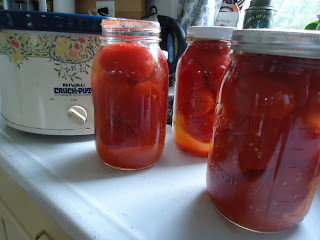
Final 2012 tomatoes
In anticipation of a busy garlic harvest season, I am making a big pan of chard lasagna on Sunday to freeze for quick late night meals. So today the last of the 2012 tomatoes went into the slow cooker to make the sauce...

Tuesday, May 28, 2013
Garlic - and canning season (Pickled Green Garlic)
The garlic is looking good. Although we are weeks behind where it was maturity-wise last year at this time. We've completed our first pass at weeding the beds.

All tomatoes are transplanted. Varieties this year are Hillbilly Potato Leaf, Illini Star, Blonkopfchen, Green Zebra, Martino Romano, Dester and Kellogg's Breakfast. (Our forever thanks to Penny at Wishful Acres for introducing us to Kellogg's Breakfast!)
Kale, Swiss Chard and a couple of pepper varieties are also transplanted. Pepper varieties transplanted are Georgia Flame, Beaver Dam, Lipstick and Alma Paprika.
Memorial Day saw summer canning start again.


All tomatoes are transplanted. Varieties this year are Hillbilly Potato Leaf, Illini Star, Blonkopfchen, Green Zebra, Martino Romano, Dester and Kellogg's Breakfast. (Our forever thanks to Penny at Wishful Acres for introducing us to Kellogg's Breakfast!)
Kale, Swiss Chard and a couple of pepper varieties are also transplanted. Pepper varieties transplanted are Georgia Flame, Beaver Dam, Lipstick and Alma Paprika.
Memorial Day saw summer canning start again.

Our first batch of pickled green garlic.
Sunday, March 7, 2010
Blight Resistant Tomatoes
I attended a session at the MOSES conference on tomato blight.
Tomato blight is caused by a fungal-like organism called Phytophthora investans which is a water borne organism. 26 Wisconsin counties experienced tomato blight outbreaks in the growing year 2009 specifically on the Solanaceae family of plants (tomato, potato, pepper, eggplants). This particular strain is unable to overwinter in soil, but since this also affects potatoes the danger is that any potatoes that were missed during harvest can still be harboring the pathogen in the soil and exposing tomato and potato plants anew in the 2010 season.
Essentially the fungus is airborne and water events cause it to spread. In layman's terms, the organism is floating around in the air and wind and when it rains or is humid, those conditions allow the activation of the organism. Morning irrigation and good airflow are helpful to slow the spread of the organism, but once it is in your fields, you need to aggressively cull infected plants immediately to stop the spread. Do NOT compost the infected plants. Most compost piles do not reach the temperature heights to kill the organism, and conversely don't get cold enough in the winter to likewise kill the organism. Burning or bagging and throwing away are the recommended means for disposing of infected plants.
Organic growers can use copper products which have some positive results in combating the organism, however every leaf on both side must be treated to appropriately protect the plant.
Some varieties that are allegedly blight resistant. (Although a member of the audience shared that he had many of these varieties in his production last year and he lost all of his crop). I haven't listed the entire hand-out, only those sources that I am familiar with.
Cultivar
Source(s)
Organization claiming resistance (i.e. who did the research)
Comments
Fruit Type
1. Legend
Jungs, Territorial
Cornell, Oregon State, Jungs
Excellent late blight resistance
Determinate, large round red fruits, early bearing, self-fertile, large fruit
2. Matt's Wild Cherry
Johnny's, Seeds of Change
Ingliss et al 2000
Good late blight tolerance (and frost tolerant)
Indeterminate, rampant vines, many fruits per plant, fruit clusters, red cherry, 1/2" size, sweet flavor
3. Juliet
Johnny's
Cornell, Dillon et al 2000
Some resistance to late blight in NY trials, crack resistant fruit
Indeterminate, red grape tomato
4. Golden Sweet
Johnny's
Cornell
Some resistance to late blight, crack resistant fruit
Indeterminate, yellow grape
5. Pruden's Purple
Johnny's, Seeds of Change, many others
Inglis et all 2000
Good resistance to late blight, tomato vining
Indeterminate, brandywine type, color is purple to b lack
6. Green Zebra
lots of suppliers
WI field observations 2009
Some resistance to late blight seen during 2009 outbreak, no other disease resistance claims
Indeterminate, 2" round, gold with green stripes, green flesh, lemon-lime flavor
7. Roma
lots of suppliers
WI Field observations 2009
Some resistance to late blight seen during 2009 outbreak, also resistant to Verticillium wilt,
Fusarium wilt 1, and Altarnaria stem canker
Determinate, pear shaped, red plum fruit, open pollinated, few seeds in meaty fruit, good for canning and sauces
8. Aunt Ruby's German Green
Seed Savers and others
Cornell
Moderate resistance to late blight
1 lb fruit, pale greenish color, with a slightly flattish shape
9. Black Plum
lots
Cornell
High resistance to late blight
Indeterminate, sweet, meaty, oval shaped fruit
10. Brandywine
lots
Cornell
Moderate resistance to late blight
Large, meaty, 1 lb fruit, pink to reddish color
Two potato varieties that showed some resistance to late blight
1. Defender
Russett -type
2. Jacquelyn Lee
Yellow variety
And the forecast for 2010? No way to tell. I guess we will know soon enough.
Happy planting!
Tomato blight is caused by a fungal-like organism called Phytophthora investans which is a water borne organism. 26 Wisconsin counties experienced tomato blight outbreaks in the growing year 2009 specifically on the Solanaceae family of plants (tomato, potato, pepper, eggplants). This particular strain is unable to overwinter in soil, but since this also affects potatoes the danger is that any potatoes that were missed during harvest can still be harboring the pathogen in the soil and exposing tomato and potato plants anew in the 2010 season.
Essentially the fungus is airborne and water events cause it to spread. In layman's terms, the organism is floating around in the air and wind and when it rains or is humid, those conditions allow the activation of the organism. Morning irrigation and good airflow are helpful to slow the spread of the organism, but once it is in your fields, you need to aggressively cull infected plants immediately to stop the spread. Do NOT compost the infected plants. Most compost piles do not reach the temperature heights to kill the organism, and conversely don't get cold enough in the winter to likewise kill the organism. Burning or bagging and throwing away are the recommended means for disposing of infected plants.
Organic growers can use copper products which have some positive results in combating the organism, however every leaf on both side must be treated to appropriately protect the plant.
Some varieties that are allegedly blight resistant. (Although a member of the audience shared that he had many of these varieties in his production last year and he lost all of his crop). I haven't listed the entire hand-out, only those sources that I am familiar with.
Cultivar
Source(s)
Organization claiming resistance (i.e. who did the research)
Comments
Fruit Type
1. Legend
Jungs, Territorial
Cornell, Oregon State, Jungs
Excellent late blight resistance
Determinate, large round red fruits, early bearing, self-fertile, large fruit
2. Matt's Wild Cherry
Johnny's, Seeds of Change
Ingliss et al 2000
Good late blight tolerance (and frost tolerant)
Indeterminate, rampant vines, many fruits per plant, fruit clusters, red cherry, 1/2" size, sweet flavor
3. Juliet
Johnny's
Cornell, Dillon et al 2000
Some resistance to late blight in NY trials, crack resistant fruit
Indeterminate, red grape tomato
4. Golden Sweet
Johnny's
Cornell
Some resistance to late blight, crack resistant fruit
Indeterminate, yellow grape
5. Pruden's Purple
Johnny's, Seeds of Change, many others
Inglis et all 2000
Good resistance to late blight, tomato vining
Indeterminate, brandywine type, color is purple to b lack
6. Green Zebra
lots of suppliers
WI field observations 2009
Some resistance to late blight seen during 2009 outbreak, no other disease resistance claims
Indeterminate, 2" round, gold with green stripes, green flesh, lemon-lime flavor
7. Roma
lots of suppliers
WI Field observations 2009
Some resistance to late blight seen during 2009 outbreak, also resistant to Verticillium wilt,
Fusarium wilt 1, and Altarnaria stem canker
Determinate, pear shaped, red plum fruit, open pollinated, few seeds in meaty fruit, good for canning and sauces
8. Aunt Ruby's German Green
Seed Savers and others
Cornell
Moderate resistance to late blight
1 lb fruit, pale greenish color, with a slightly flattish shape
9. Black Plum
lots
Cornell
High resistance to late blight
Indeterminate, sweet, meaty, oval shaped fruit
10. Brandywine
lots
Cornell
Moderate resistance to late blight
Large, meaty, 1 lb fruit, pink to reddish color
Two potato varieties that showed some resistance to late blight
1. Defender
Russett -type
2. Jacquelyn Lee
Yellow variety
And the forecast for 2010? No way to tell. I guess we will know soon enough.
Happy planting!
Subscribe to:
Posts (Atom)