Farming is healthy and moral and respectable and in the long run may become profitable.
- Chase County (Kansas) Leader, March 6, 1871
I am reading a great book: Harvest: an anthology of farm writing edited by Wheeler McMillen
Published in 1964, this is an anthology of writing that concern farming in America. It contains excerpts of writings of Christopher Columbus, George Washington, Captain John Smith, John Adams, Thomas Jefferson, James Madison, John Quincy Adams, Nathaniel Hawthorne, Daniel Webster, Ralph Waldo Emerson and others. It is quite a fascinating read! George Washington writes about his sheep and cover crops!!

A journal of our adventures in construction, garlic farming and growing our own food as we transition from life in Chicago to life in Southwestern Wisconsin.
Tuesday, August 17, 2010

Monday, August 16, 2010
Wisc Harvest - and Pickles comes home today!
We were in Wisc from Wed afternoon through Sunday. It was hot, hot, hot.
We worked with our farm mentors on Thursday for a harvest day experience. (Did I mention it was hot?!?!) We harvested lettuce, zucchini, cucumbers, eggplant, tomatoes (Sun-Gold, yellow-minis, slicers, heirlooms). It was good for us to see the assembly line way that these farmers manage their harvest. The packing crates, the wash station, the immediate cool down to remove the heat from the field. All stuff I've read about but great to see in action. We continue to be impressed by the organization, attention to detail, and high standards of our farm mentors. We learned a lot.
We spent Fri and Sat working at our farm. I will post more about that later.
Pickles is on the mend and comes home today. She bounced back well and I think, as Jena suspected, that she had a vaccine reaction instead of true distemper. Our problem now is introducing her to the two at home as we are leaving again on Wednesday for a long weekend of relaxation in northern Wisc. (No work! yea!) This leaves us very little time to get all 3 accustomed to one another before we leave. Depending on how it goes, we may need to board Pickles again.
We worked with our farm mentors on Thursday for a harvest day experience. (Did I mention it was hot?!?!) We harvested lettuce, zucchini, cucumbers, eggplant, tomatoes (Sun-Gold, yellow-minis, slicers, heirlooms). It was good for us to see the assembly line way that these farmers manage their harvest. The packing crates, the wash station, the immediate cool down to remove the heat from the field. All stuff I've read about but great to see in action. We continue to be impressed by the organization, attention to detail, and high standards of our farm mentors. We learned a lot.
We spent Fri and Sat working at our farm. I will post more about that later.
Pickles is on the mend and comes home today. She bounced back well and I think, as Jena suspected, that she had a vaccine reaction instead of true distemper. Our problem now is introducing her to the two at home as we are leaving again on Wednesday for a long weekend of relaxation in northern Wisc. (No work! yea!) This leaves us very little time to get all 3 accustomed to one another before we leave. Depending on how it goes, we may need to board Pickles again.
Tuesday, August 10, 2010
Feline Panleukopenia Virus (FPV) aka Feline Distemper
Initially our veterinarian thought Pickles was suffering from a mild case of dehydration. Upon further symptoms and tests, she has been diagnosed with feline distemper and given a rate of survival of 40%. Today and tomorrow are the critical days and we will be able to tell if she is responding to treatment or not.
FPV is in the same viral family as canine parvo. It is highly contagious and a very stable virus in the environment. I have read that it can last for years at room temperature and is highly resistant to most cleaners except bleach. Most all cats have been exposed to feline distemper in their lives due to the resistance of the virus - fortunately, the killed FPV vaccination is remarkably effective at protecting against the disease. (Side note: How did I do research before the internet?!?) Pickles had her first vaccination on Friday. I did ask if perhaps we could be seeing a reaction similar to the disease from the vaccination (similar to when humans get a flu vaccine and have mild flu symptoms); he didn't think so.
Pickles had been living in our bathroom so I have bleached that room. Thankfully we hadn't introduced her to Gracie and Georgie yet, however, the transmission of this virus can occur on hands, shoes, etc.
I guess this is part of the deal when you pick up strays. I certainly wasn't expecting this (I'm sure no one ever is!).
FPV is in the same viral family as canine parvo. It is highly contagious and a very stable virus in the environment. I have read that it can last for years at room temperature and is highly resistant to most cleaners except bleach. Most all cats have been exposed to feline distemper in their lives due to the resistance of the virus - fortunately, the killed FPV vaccination is remarkably effective at protecting against the disease. (Side note: How did I do research before the internet?!?) Pickles had her first vaccination on Friday. I did ask if perhaps we could be seeing a reaction similar to the disease from the vaccination (similar to when humans get a flu vaccine and have mild flu symptoms); he didn't think so.
Pickles had been living in our bathroom so I have bleached that room. Thankfully we hadn't introduced her to Gracie and Georgie yet, however, the transmission of this virus can occur on hands, shoes, etc.
I guess this is part of the deal when you pick up strays. I certainly wasn't expecting this (I'm sure no one ever is!).
Monday, August 9, 2010
New addition

I found a kitten on Thursday. We have decided to keep her. We weren't really in the market for a new cat (we have two); we were considering a dog. On Thursday I was told that the dog that we were interested in wasn't a good fit for us (she needed hip surgery and our lifestyle and 2nd floor Chicago apartment was too much activity). That very same day I found this little one crying outside.
Meet Pickles. She is approximately 8 weeks old.
Wednesday, August 4, 2010
Book Review
Excerpt from: The Town that Food Saved: How One Community Found Vitality in Local Food by Ben Hewitt
This is a community steeped in agrarian values and skills, and it plies those values and skills on an endowment of fertile soil.
and
To engage in a local food system is to assume a level of responsibility for the very thing that keeps you alive. If you're a producer, you assume that responsibility for yourself and your customers. If you're a merchant, you assume the responsibility of connecting farmer and consumer and of ensuring that each walks away from the transaction the better for it. If you're a consumer, your primary responsibility isn't to yourself, but to the people who keep your sustenance trickling down its truncated supply chain. Which, conveniently enough, only ensures your continued survival.
Ben writes is a very no-nonsense style about the blue-collar town of Hardwick, VT and the influx of young agrepreneurs and the change to the community - both good and bad. I plan to attend a book discussion at Driftless Market next week on the book, local food and the current and potential impact on Platteville and the surrounding area.
This is a community steeped in agrarian values and skills, and it plies those values and skills on an endowment of fertile soil.
and
To engage in a local food system is to assume a level of responsibility for the very thing that keeps you alive. If you're a producer, you assume that responsibility for yourself and your customers. If you're a merchant, you assume the responsibility of connecting farmer and consumer and of ensuring that each walks away from the transaction the better for it. If you're a consumer, your primary responsibility isn't to yourself, but to the people who keep your sustenance trickling down its truncated supply chain. Which, conveniently enough, only ensures your continued survival.
Ben writes is a very no-nonsense style about the blue-collar town of Hardwick, VT and the influx of young agrepreneurs and the change to the community - both good and bad. I plan to attend a book discussion at Driftless Market next week on the book, local food and the current and potential impact on Platteville and the surrounding area.
Friday, July 16, 2010
Hog butchering - photo alert
Skip this post if you don't want to see photos of hog butchering.
I went to my new friend Anna's house last night to watch her butcher a hog. She buys a pasture raised Berkshire hog from a small farm near where my grandma lives (western IL - and where we bought the plow). She went to pick it up from the processor yesterday and drove it back to Chicago. I went over last night after work to help her cut the two sides into primals. I learned a lot about cooking the different cuts.
First we prepared her workspace. Having a towel to set the knives on keeps them all in one place - especially since we were both in flipflops. We also wiped down the surfaces with bleach water.

This is one of the full halves. It is big and heavy. It took two of us to carry it in from her car. Note the tail on the lower left.

Look at the fat underneath the skin! Anna gets her hogs with the skin on. She likes it for additional flavoring for smoking and cooking.

This shows the kidney and the white area underneath the kidney (to the left) is the lard. Anna renders her own lard. I asked if it smells bad (which is what I have read) she disagreed and said that it is fine. She soaks the kidneys in milk overnight and was going to have fried kidney today for lunch. Soaking in milk negates the urea.


This is a close up of the kidney.

The head. In years past, she hasn't always gotten the head. She cut out the tongue and is going pickle it. She is thinking about head cheese this year.


I went to my new friend Anna's house last night to watch her butcher a hog. She buys a pasture raised Berkshire hog from a small farm near where my grandma lives (western IL - and where we bought the plow). She went to pick it up from the processor yesterday and drove it back to Chicago. I went over last night after work to help her cut the two sides into primals. I learned a lot about cooking the different cuts.
First we prepared her workspace. Having a towel to set the knives on keeps them all in one place - especially since we were both in flipflops. We also wiped down the surfaces with bleach water.

This is one of the full halves. It is big and heavy. It took two of us to carry it in from her car. Note the tail on the lower left.

Look at the fat underneath the skin! Anna gets her hogs with the skin on. She likes it for additional flavoring for smoking and cooking.

This shows the kidney and the white area underneath the kidney (to the left) is the lard. Anna renders her own lard. I asked if it smells bad (which is what I have read) she disagreed and said that it is fine. She soaks the kidneys in milk overnight and was going to have fried kidney today for lunch. Soaking in milk negates the urea.


This is a close up of the kidney.

The head. In years past, she hasn't always gotten the head. She cut out the tongue and is going pickle it. She is thinking about head cheese this year.

She bakes the feet, then splits them open, stuffs them with stuffing and continues additional baking.

This took the intimidation factor out of it for me. Overall, if you have a good knife, a strong stomach and a book you can figure your way around butchering. It was a great experience. I learned a ton!

This took the intimidation factor out of it for me. Overall, if you have a good knife, a strong stomach and a book you can figure your way around butchering. It was a great experience. I learned a ton!

Thursday, July 1, 2010
Weather
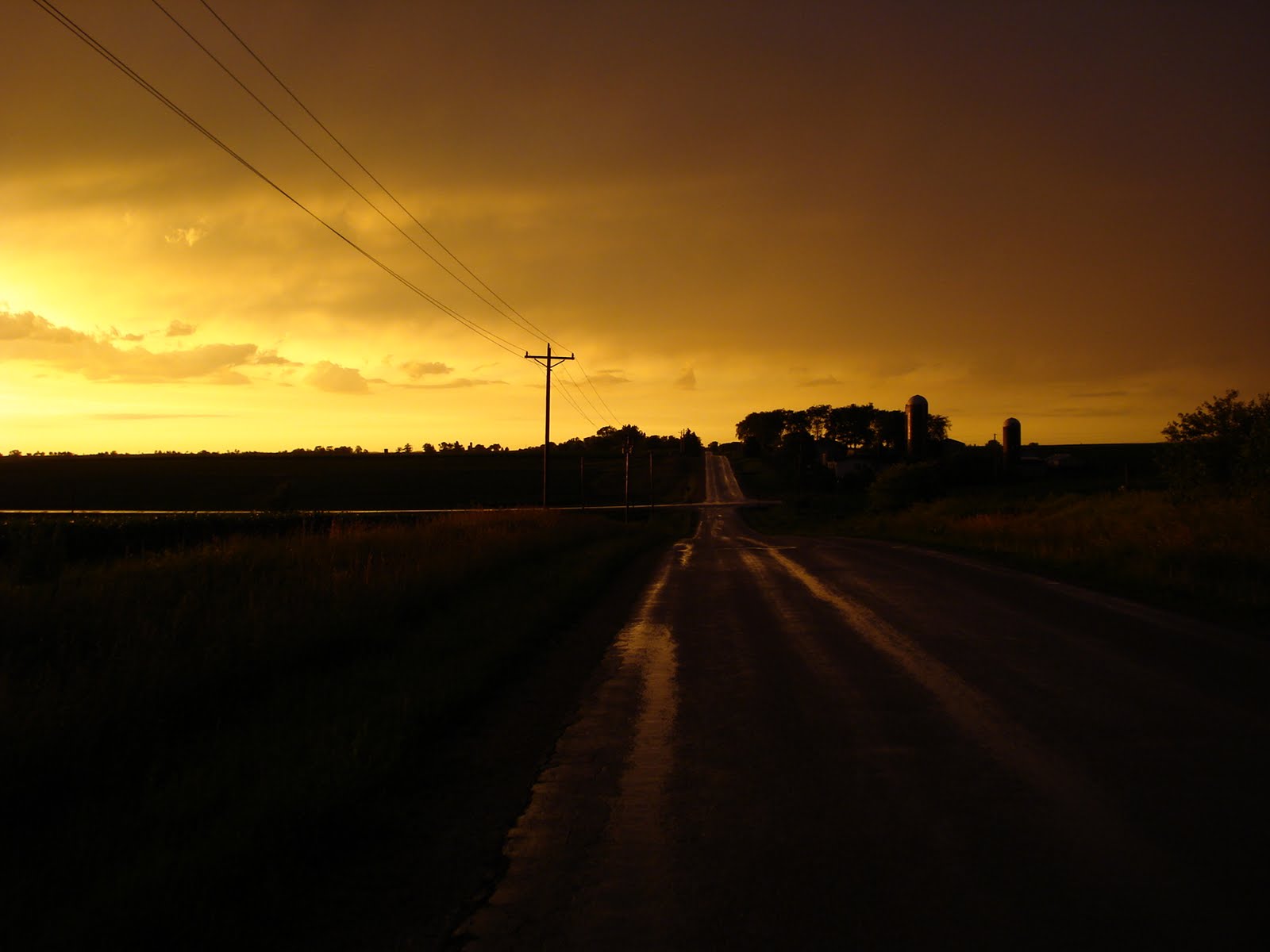
Two weeks ago I took a solo trip to Wisc to volunteer for the morning on our mentor's farm. I wasn't able to get a head start on the traffic, so I left Chicago at 4:00 pm on a Friday in a storm. It took me almost 5 hours to get to our church/home - which is about an hour longer than it normally takes when leaving in traffic. I drove in rain the whole way. Upon arrival, I experienced weather that was different in each direction I looked.




Subscribe to:
Posts (Atom)